


American film actors are not just the faces of an industry, but carriers of an entire cultural system. Classical Hollywood already worked with the so-called star system: public visibility, press photography, and recognizability were deliberately used to generate demand for films. That is why star portraits still function today as a kind of cultural shorthand — a single image can convey an era, a genre, a mood, and an attitude.
For today’s media and content formats, that remains highly relevant. Iconic images often outlive the original occasion and are later revisited, quoted, and recontextualized years or even decades afterward. That is exactly where their strength lies: they do not work merely as illustration, but as a visual memory. IMAGO repeatedly describes this mechanism in its own articles as the interplay of achievement, social context, and media circulation.
If you work with entertainment topics, you therefore need more than mere celebrity visibility. You need recognizable motifs, historical depth, clean metadata, and clear rights. This combination is also central to the IMAGO target customer profile: professional decision-makers in editorial, marketing, agency, and production environments often work under time pressure, need legally secure visuals, and benefit from a strong archive with thematic breadth.
This article places Hollywood legends in context, outlines the key lines of development from the studio era to the present, and explains which Hollywood star photos, which US actors, and which entertainment archive are especially valuable for your format. It also addresses the crucial question of how to license this material legally through IMAGO.
Why American film actors are so effective for your format
The biggest advantage of strong star imagery is its immediate readability. Audiences do not need Meryl Streep, Denzel Washington, Marilyn Monroe, or Leonardo DiCaprio to be explained to them first. These names and faces are already charged with meaning. For articles, dossiers, documentary formats, magazine pages, social posts, or campaigns, that means you gain instant attention while saving explanatory space at the same time.
In practice, American film actors are especially valuable for four reasons:
-
Recognizability: A familiar face creates instant orientation.
-
Narrative compression: One image can capture a career, a zeitgeist, and a screen persona at once.
-
Format flexibility: The same image can work in news, features, documentaries, or social snippets.
-
Archive value: Star imagery remains relevant for years — for anniversaries, awards coverage, obituaries, birthdays, or retrospectives.
There is also an additional factor for fast digital formats: strong images often determine attention within seconds. IMAGO makes this point very clearly in its own articles on visual impact — expression, sharpness, composition, and cultural charge turn a motif into a click-worthy asset. For editorial teams and brands, that is not decorative extra value, but a real performance factor.
That is why, especially in entertainment contexts, it makes sense to think of stars not as isolated topics but as visual topic clusters. Monroe carries different connotations in our visual memory than Streep. Denzel Washington works differently from James Dean. Michael B. Jordan sends different signals than Humphrey Bogart. If you understand that, you not only research faster, but you also select with greater precision.
From the studio era to the present: How US actors shaped Hollywood
The studio era: surface, control, and immortal presence
Classical Hollywood was heavily shaped by the studio system. A handful of major companies controlled production, distribution, and cinema chains for long stretches — and with that, the building of stars as well. In that environment, the faces that are still considered the embodiment of film history today were created. Publicity stills, magazine portraits, and premiere photos were not a side note, but part of the marketing machine.
That is precisely why images from that period still appear so cohesive and iconic. Katharine Hepburn, Humphrey Bogart, James Stewart, Bette Davis, or Marilyn Monroe are not just famous names, but condensed expressions of entire cinematic codes. Hepburn stands for independence and intelligence, Bogart for dry coolness, Monroe for glamour and media self-stylization. Hepburn’s singular place in Academy history further underscores her long-term impact: the Academy describes her as the only person to have won four acting awards. At the same time, Hattie McDaniel’s Oscar for Gone with the Wind marks a historic turning point, as she became the first Black person to win a competitive Academy Award.
For your format, this means that anyone drawing on classical Hollywood is almost always working with highly condensed visual symbolism. Clothing, lighting, body language, and studio portrait aesthetics all tell part of the story. This kind of material is especially well suited to retrospectives, anniversary pieces, culture pages, historical magazines, and documentary formats.
 IMAGO / Pacific Press Agency / Matteo Nardone / Andy Warhol exhibition in Rome featuring artworks of Marilyn Monroe.
Method acting: more contradiction, more physicality, more truth
After the Second World War, the ideal of the film star shifted considerably. The polished studio face lost some of its dominance, and the camera moved closer to ambivalence, vulnerability, and psychological tension. Central to this shift was the environment of the Actors Studio and the rise of method acting. The Library of Congress documents how formative this environment became; the Strasberg papers even record that Marilyn Monroe, Paul Newman, and Harry Belafonte, among others, appeared at the studio in 1955. Britannica also describes the influence of this school very clearly and names Marlon Brando, James Dean, Meryl Streep, Paul Newman, Robert De Niro, Al Pacino, and Dustin Hoffman as especially defining figures of this tradition.
In visual terms, this marked a fundamental change. Marlon Brando and James Dean no longer embody the controlled screen persona alone, but a new, more exposed intensity. Their faces appear less polished and more immediate, contradictory, and emotionally risky. Paul Newman brings in another kind of charisma: very clear, very present, but never purely ornamental. Images like these still work exceptionally well whenever a format is meant to illustrate not just glamour, but transformation, tension, or cultural rupture.
 IMAGO / United Archives / Director NICHOLAS RAY with JAMES DEAN on the set of Rebel without a Cause, 1955.
Sidney Poitier: screen presence and the history of representation
A key figure in this development is Sidney Poitier. He united dignity, authority, and emotional precision with a historic shift in American screen culture. The Academy notes that Poitier won the Oscar for Best Actor in 1964 for Lilies of the Field, becoming the first African American to do so. His filmography and visual presence therefore matter not only cinematically, but socially as well.
For editorial teams, Poitier is especially valuable because his images are almost always readable on several levels at once. They tell film history, civil rights history, and star history simultaneously. These are exactly the kinds of motifs that give an entertainment feature real substance, because they go far beyond a simple celebrity depiction.
New Hollywood: antiheroes, friction, and directorial authorship
With New Hollywood, the function of the star changed yet again. Britannica describes the movement, roughly spanning from the mid-1960s to the early 1980s, as a clear departure from the old studio system and a shift toward more director-driven creativity and experimentation. That also changed the visual language: away from the smoothly controlled pose and toward ambivalence, grit, urban hardness, and psychological density.
In this phase, Al Pacino, Robert De Niro, Jack Nicholson, and many others become ideal archive figures. Their faces convey not just fame, but conflict. They stand for antiheroes, moral gray zones, and a cinema more interested in inner tension than flawless surfaces. For dossiers, essays, cultural journalism, and documentary formats, that is pure gold, because these motifs carry far more context than a generic event photo.
 IMAGO / ZUMA Press Wire / Oscar nominees ROBERT DE NIRO and AL PACINO arrive on the red carpet of the 92nd Oscars at the Dolby Theatre in Hollywood, California, on Sunday, February 9, 2020.
Meryl Streep: institution and exception
With Meryl Streep, another factor enters the picture: institutional authority. In 2018, the Academy noted that, with her 21st nomination, she extended her lead as the most nominated performer. At the same time, IMAGO positions Streep as a figure whose career has come to define excellence in acting.
For your format, Streep is therefore more than a prominent name. She stands for continuity, quality, and cross-generational presence. Anyone working with her can easily combine several decades of film and media history in a single image spread — from early roles to Oscar moments to later festival and press appearances.
 IMAGO / aal.photo / A. Quintero / Meryl Streep and Anne Hathaway walk the runway during the premiere parade of The Devil Wears Prada 2 at Museo Anahuacalli on March 30, 2026, in Mexico City.
The 1990s and 2000s: global visibility and broad resonance
By the 1990s and 2000s, Hollywood had become a truly global real-time phenomenon. Tom Hanks is a prime example of the US actor whose image instantly signals trust, accessibility, and emotional clarity. The Academy noted in 1995 that Hanks became the first performer since Spencer Tracy to win two consecutive Best Actor Oscars. Denzel Washington, by contrast, combines classic screen authority with political and emotional sharpness; the Academy highlights his Oscar wins for Glory and Training Day. Leonardo DiCaprio, meanwhile, evolved from worldwide Titanic idol to prestige and auteur-cinema star, winning the Oscar for The Revenant in 2016.
These three names demonstrate how differently star imagery can function. Hanks conveys warmth and dependability, Washington gravity and conflict awareness, DiCaprio transformation and career arc. That is exactly why they are so attractive for visual formats. They allow for very different tones — from accessible mainstream retrospectives to sophisticated film essays.
 IMAGO / Cover-Images / 2025 Tribeca Festival — opening premiere of the documentary "Billy Joel: And So It Goes" at the Beacon Theatre, featuring Tom Hanks (left), Robert De Niro, and Jane Rosenthal.
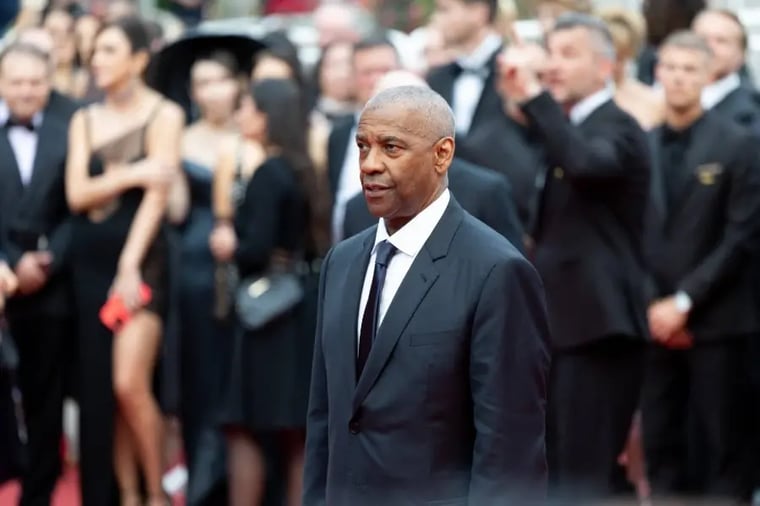 IMAGO / Christian Ender / Denzel Washington during the red carpet for Highest 2 Lowest at the 78th Cannes Film Festival in 2025.
 IMAGO / ZUMA Press Wire / Rodrigo Reyes Marin / American actor Leonardo DiCaprio attends a press conference for the film "Once Upon a Time In Hollywood" in central Tokyo in August 2019.
The present day: film, series, fashion, and platform culture converge
Today, the field is even broader. Michael B. Jordan represents the intersection of franchise success, producing, and conversations around diversity; IMAGO describes him as an actor whose intensity shapes every role and who has also established himself as a producer. Viola Davis brings together institutional recognition and emotional force; her Oscar for Fences is a milestone both institutionally and artistically. Zendaya, meanwhile, shows how tightly film, television, fashion, and event culture are now intertwined.
For your format, that has one clear consequence: contemporary Hollywood imagery is almost never just film imagery. It is also event imagery, fashion imagery, social imagery, and brand imagery at the same time. That is precisely why selection needs to be more precise. A premiere photo tells a different story from a set still, and a festival portrait tells a different story from an awards moment.
 IMAGO / Future Image / Michael B. Jordan at the 2026 Vanity Fair Oscar Party held in connection with the 98th Academy Awards at the David Geffen Gallery at LACMA, Los Angeles, March 15, 2026.
Hollywood star photos: Which motifs truly carry a story
Not every image of a star is automatically strong. IMAGO makes a very clear point in other image-related contexts: pictures are most effective when they are distinctive, emotional, and historically resonant. Applied to Hollywood star photos, that means an image should either capture an unrepeatable moment, convey a clear mood, or place a career within a larger context.
In practice, five image types tend to work especially well:
-
Portrait photography: ideal for evergreen pages, essays, author-driven pieces, and dossiers, because they make the face legible as an iconic surface.
-
Premiere and red-carpet photos: strong for current hooks, glamour spreads, and entertainment industry coverage.
-
Set and scene stills: especially useful when an article focuses more heavily on roles, genres, or specific films.
-
Backstage and press images: valuable for authenticity, production context, and visual variety.
-
Archive series across decades: perfect when change, career trajectory, or period comparison is the actual story.
The key point is almost always fit rather than pure beauty. The most spectacular image is not automatically the best one. For an analytical text about Sidney Poitier, a calm role-based image can be more meaningful than a late-career event portrait. For a feature on Meryl Streep as an institution of acting, a combination of an early press photo, an Oscar appearance, and a current festival image is often stronger than three nearly identical close-ups.
Festival and awards material becomes even more valuable when different situations can be combined. The IMAGO article on Cannes illustrates this perfectly: archive material around a festival does not consist only of red-carpet imagery, but also of press conferences, screenings, and award ceremonies. That is what creates visual dramaturgy instead of a simple celebrity gallery.
We advise you on the right images from the film industry — including custom media packages.
The entertainment archive as a strategic advantage
A strong entertainment archive does not simply answer the question, “Do we have a photo of person X?” It answers the far more important question, “Do we have the right photo of person X for this exact context?” That is a crucial difference. In professional use, availability alone is not enough — context depth matters: when was the image made, in what setting, with whom, and in relation to which film, festival, or award?
Major public collections show very clearly how valuable that depth can be. The Library of Congress describes its “Unshredded Nostalgia Collection” as a body of 30,000 show business stills, while the Look Magazine Photograph Collection comprises around 5 million images. Collections like these make one thing obvious: an archive does not simply store material, it layers time. That is exactly why editorial teams with access to a strong archive can tell more than just “who was there.”
For professional use, however, scale alone is not decisive. What matters is tagging quality. An archive only becomes truly powerful when date, occasion, location, film reference, accompanying persons, caption, rights, and variants can all be found cleanly. Then the same person can be told in different ways: as a newcomer, as an Oscar guest, as a presence on set, as a politically charged figure, or as the subject of a whole-era retrospective.
IMAGO explicitly positions its entertainment images and videos for film premieres, music events, fashion shows, and celebrity appearances for editorial use. For production and content teams, that matters because it brings together current relevance and archive depth. A Cannes moment or an awards image is then not simply attractive, but immediately usable within broader storylines.
Another practical advantage lies in serial usability. If you are working on Meryl Streep’s birthday, the anniversary of a Denzel Washington film, or a DiCaprio retrospective, you usually do not need one image, but often a logical image sequence. That is exactly where a solid entertainment archive separates itself from a random collection of isolated visuals.
Which American film actors fit which narrative
When you research American film actors, it helps to assign them narratively rather than by popularity alone. Not every star serves the same purpose. A precise format therefore begins with the question: What meaning should this face carry?
For glamour and media history, Marilyn Monroe, Katharine Hepburn, Humphrey Bogart, Bette Davis, and James Stewart are especially suitable. These names work exceptionally well when you want to write about classical Hollywood, studio culture, style codes, or early constructions of stardom. They bring with them an aesthetic that immediately looks like cinema history.
For rupture, intensity, and modernization, Marlon Brando, James Dean, Paul Newman, Al Pacino, and Robert De Niro are ideal. Here the focus is less on polished surface and more on the transformation of acting itself. These names are powerful when a text wants to show change: more psychological depth, more friction, more city, more modernity.
For representation, authority, and historical framing, Sidney Poitier, Denzel Washington, Viola Davis, and Meryl Streep are especially strong. They combine artistic achievement with social legibility and institutional recognition. These motifs work not only in film-related pieces, but also in cultural and historical formats.
For broad pop culture relevance and global accessibility, Tom Hanks, Leonardo DiCaprio, Julia Roberts, and Michael B. Jordan are strong anchors. They combine high recognizability with clear role associations and very different tonal possibilities — from warm mainstream storytelling to prestige cinema to the franchise-driven present.
The advantage of this classification lies in its motif economy. Even before the actual research begins, you already know what kind of visual language you need. Monroe often stands for glamour and media excess. Poitier stands for dignity and historical shift. De Niro and Pacino bring urban hardness and New Hollywood energy. Hanks signals warmth and trust, DiCaprio transformation and career arc, Davis authority and emotional precision. Working this way makes research faster and usually results in a much sharper final format.
How to select images for editorial, documentary, social, and marketing use
For IMAGO’s core audience, the deciding factor is not just the motif, but the entire workflow. The target customer profile makes it very clear that professional teams work under time pressure, want to avoid legal risks, and place a high value on image quality, searchability, and support. That is why the selection of star imagery should always be tied back to the final format.
Different use cases require different priorities:
-
For editorial and feature work: Prioritize context. A strong role-based image or festival photo with a clear caption often beats a generic glamour portrait.
-
For documentaries and long-form storytelling: Think in sequences. Early career, key film, award moment, and later public presence often create the real narrative together.
-
For social media and quick teasers: Choose motifs with clear emotion, strong facial expression, and good readability in smaller formats. Strong images win attention early.
-
For marketing and presentations: Check the rights especially carefully. Not every highly recognizable star image is automatically suitable for commercial use.
-
For archive-driven and anniversary formats: Prioritize variation. A famous image is useful, but a less overused one may sharpen your story significantly.
One common mistake is to reach automatically for the most famous image. That can work, but it often feels interchangeable. Quite often, the second- or third-best-known image is the better choice because it is more specific, fresher, or editorially more precise. For a text on Denzel Washington as an actor, a set photo may be more revealing than a neutral awards shot. For a piece on Meryl Streep’s career arc, a combination of an early portrait, an Oscar moment, and a current press image is much stronger than three similar festival photos.
Another key point: always treat the caption as a value carrier. Especially with US actors, the caption often determines whether the audience merely consumes an image or actually understands it. A photo of Michael B. Jordan is not simply “Michael B. Jordan,” but perhaps “premiere of Creed,” “event in Los Angeles,” “role context,” or “producer appearance.” That kind of specification is what makes an image truly useful in professional formats.
Licensing images: How to use Hollywood star photos legally through IMAGO
Anyone publishing images almost always works in an environment where copyright, personality rights, and usage purpose must be clearly separated. The key principle is simple but important: a license does not transfer ownership of the image, but rather the right to use it. Copyright remains with the respective creator or agency. IMAGO emphasizes this distinction both in its blog articles on licensing and in its information for film and documentary productions.
In practice, IMAGO offers common licensing models that define usage precisely:
-
Rights Managed (RM): generally for clearly defined, one-time uses, such as a specific article, a defined social media publication, or a certain print run.
-
Royalty Free Classic (RF): for repeated use without a separate report for each individual use, depending on the selected variant.
-
Royalty Free Premium (RF Premium): for especially flexible projects with broader scope, such as print, campaign components, packaging, or merchandising, provided the additional rights are in place.
IMAGO currently identifies these three license categories as the key models.
When it comes to images of well-known personalities in particular, the distinction between editorial and commercial use is crucial. Editorial use refers to reporting, information, and documentation — for example articles, chronicles, dossiers, educational material, or documentary formats. Commercial use includes advertising, sponsorship, product marketing, packaging, or merchandising. Additional permissions may be required for commercial uses. If your needs extend to commercial use, the client has to take care of third-party rights.
In other words, a festival image of a star may work perfectly well in an editorial article about Oscar history, but that does not automatically make it equally usable in a campaign designed to capture attention with a prominent face.
Also relevant are model release and property release. If people or private places and objects are clearly recognizable and the use is commercial, the corresponding permissions may be necessary. IMAGO explains in its own release information that, without the relevant releases, visual content cannot be used for commercial purposes. Information can be found in the metadata and the caption; creative and stock material can also be filtered specifically by release information. In the image view, you may also see details such as “MODEL RELEASE: YES/NO” and notes under “RELEASE INFO.”
For your topic, that means something very concrete: a festival photo of a star may be ideal for editorial use in an article about Cannes or about American film actors, but it is not automatically cleared in the same way for advertising or product-related brand communication. The intended use needs to be clarified before purchase — not afterward.
Access is also organized in a practical way. IMAGO provides three typical purchasing routes, each appropriate for different workflows:
-
Webshop — Single License: for individual licenses tied to a specific publication.
-
Webshop — Credit Packages: for regular buyers using credits with a validity period of 365 days.
-
Sales Manager: for larger volumes, recurring needs, or customized contractual models.
This setup is especially useful for editorial teams, agencies, and production companies with ongoing demand, because it aligns purchasing and licensing practices with the actual workflow.
Also important in practice is labeling directly on the asset. IMAGO notes that images and videos are marked as RM, RF, or RF Premium. For productions, that is helpful because you do not have to assemble the licensing framework separately. Equally important: when publishing, the creator credit must appear in the form “IMAGO / name of photographer”. Teams that work carefully usually document the license purchase, intended use, duration, territory, and credit directly in their internal workflow.
In short, a strong star image only becomes a professionally usable asset when image quality, metadata, license type, and usage purpose all align. In cases of doubt — especially for commercial projects — legal review is advisable. That creates security and helps prevent a strong image from turning into an unnecessary risk.
American film actors remain anchors of visual storytelling
American film actors are so valuable for professional formats because they carry far more than fame. They bundle contemporary history, genre codes, media logics, emotions, and often broader social shifts as well. That is exactly why they work so well across essays, features, documentaries, culture pieces, social formats, and brand presentations.
What matters most, however, is selection. The loudest image is not the best one — the most precise one is. A strong entertainment feature gains depth when you read faces not just as stars, but as visual narrative axes: Monroe for glamour, Poitier for the history of representation, De Niro for New Hollywood toughness, Streep for institutional excellence, Washington for authority, DiCaprio for career transformation, and Michael B. Jordan for the present and for shifts within the industry.
If you regularly work with film topics, retrospectives, festival coverage, or documentary projects, a well-structured entertainment archive with clear licensing, reliable metadata, and professional support is therefore worth the investment. That is where Hollywood legends unfold their greatest value — not as a simple celebrity gallery, but as robust, legally usable material for your next format.
To discuss your specific needs or explore personalized solutions, we invite you to contact our Sales team. Our specialists can guide you through the image selection and licensing process, ensuring you find the perfect visual content for your projects.