
.webp)
Wimbledon, officially The Championships, Wimbledon, is widely regarded as the most historically significant grass‑court tournament in world tennis and has been held annually in London since 1877. Its special status stems from sustained tradition, sporting quality, and global attention. This overview takes you step by step through its history and development, its place in the tennis calendar, traditions, tournament structure, records, current media and audience aspects, and the highlights of 2024 and 2025. The presentation is aimed at editorial teams, agencies, brands, creators, NGOs, and educational institutions seeking compact, reliable information. IMAGO provides comprehensive image and video material to support this editorial context.
History and Development
On July 9, 1877, the All England Croquet and Lawn Tennis Club staged the first grass‑court tournament in Wimbledon; 22 amateurs competed only in men’s singles, with Spencer Gore emerging as champion. Women’s singles (won by Maud Watson) and men’s doubles followed in 1884, with women’s doubles and mixed doubles added in 1913.
As the tournament grew in stature, the club moved to Church Road in 1922 and opened the later‑iconic Centre Court. Play was suspended during World War I (1915–1918), World War II (1940–1945), and in 2020 due to the COVID‑19 pandemic. The Open Era, beginning in 1968, opened the event to professionals and cemented its place in the modern game.
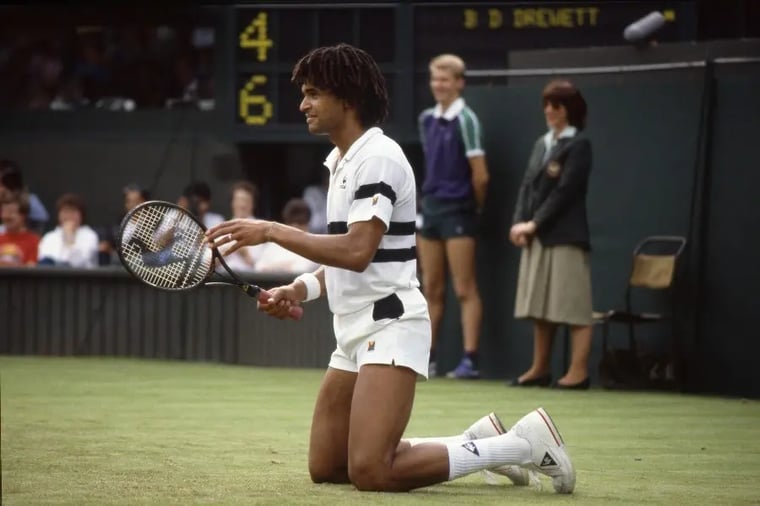
IMAGO / Sven Simon / Yannick NOAH, Frankreich, Tennisspieler, Tennis, Aktion, Tennis, All England Lawn Tennis and Croquet Club Championships, undated photo 1987.
Place in the Global Tennis Calendar
Wimbledon is one of the four Grand Slam tournaments and marks the peak of the short grass season in late June and early July. As the only major played on natural grass, it shapes the pace of play and emphasizes serving, returning, and net skills. Traditionally scheduled between the French Open (clay) and the North American hard‑court swing, the two weeks at Wimbledon regularly form the media focal point of the tennis summer. For players, ranking points, event prestige, and visibility are central incentives.
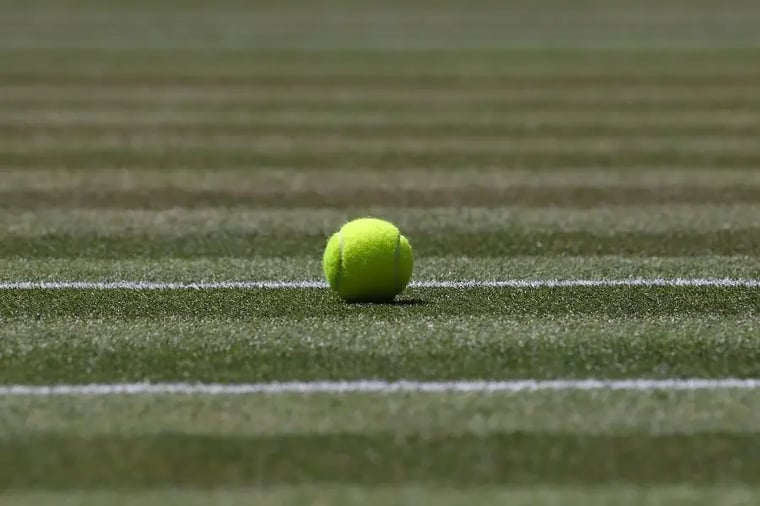
IMAGO / Jürgen Hasenkopf / Wimbledon Feature, tennis ball on the grass, close-up, detail.
Traditions and Distinctive Features
A defining characteristic is the strict all‑white dress code for players — from shoes to headbands. The rule dates back to the 19th century and remains in force; since 2023, colored undershorts have been permitted for comfort reasons.
The spectators are part of the signature image: strawberries and cream are a summer classic on the grounds, often accompanied by Pimm’s No. 1 Cup. Equally characteristic is the natural grass, whose maintenance long influenced scheduling. The formerly idle “Middle Sunday” was abolished from 2022; Wimbledon now runs regularly across 14 days.
The Queue — the orderly line for day tickets — is part of fan culture. On Centre Court, the Royal Box prescribes particular etiquette when senior royals are present. There is still no courtside advertising; the visual identity remains consistently restrained in green and purple.
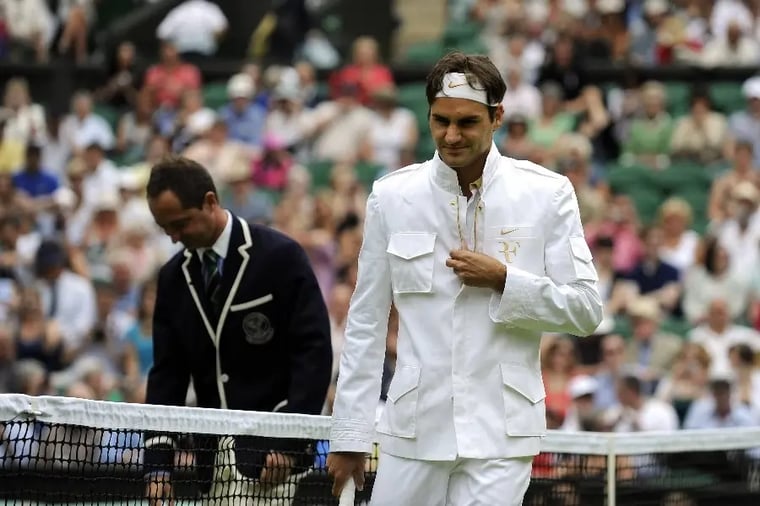
IMAGO / Paul Zimmer / Roger Federer (Switzerland) - Entrance in white Nike dress with his initials Tennis Men All England Championships 2009, ATP Tour, Grand Slam, Single image Wimbledon, London.
Tournament Structure and Schedule
The singles draws consist of 128‑player main fields for women and men in a single‑elimination format. Seven match wins are required to claim the title. Men play best‑of‑five sets; women play best‑of‑three. Entry is via rankings, qualifying, or wild cards.
In doubles, 64 teams compete (men’s/women’s), and mixed doubles features 32 pairs. Junior events as well as legends and invitational competitions are also held.
A milestone is the step‑by‑step integration of wheelchair tennis: doubles debuted first, followed by singles (from 2016) and quad divisions (from 2019). All categories now run in parallel within the Grand Slam framework.
The schedule runs from Monday (Week 1) to Sunday (Week 2); the women’s final is traditionally on the second Saturday, the men’s final on the second Sunday. Roofs over Centre Court and No. 1 Court reduce rain delays and support reliable TV times.
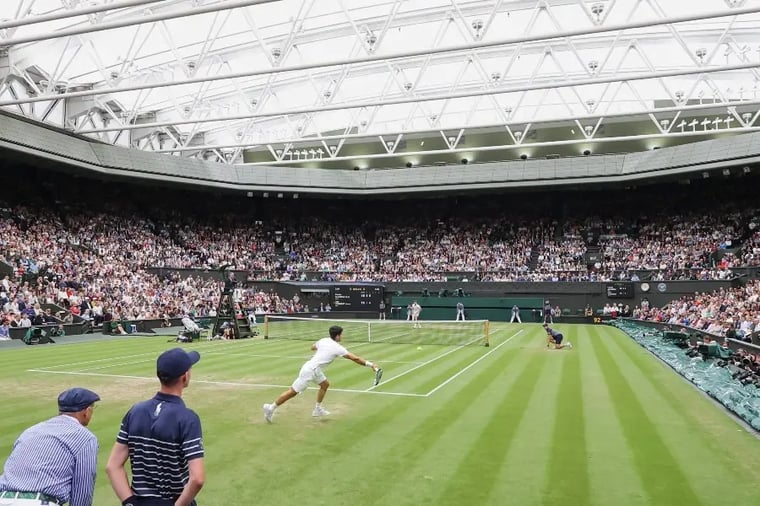
IMAGO / Hasenkopf / Carlos Alcaraz (ESP) vs. Ugo Humbert on the Centre Court with a closed roof, overview.
Records and Legendary Moments
In men’s singles, Roger Federer holds the record with eight titles; Pete Sampras and Novak Djoković follow with seven each. In women’s singles, Martina Navrátilová leads with nine titles; counting doubles and mixed, she has 20 Wimbledon trophies — as does Billie Jean King. Boris Becker won in 1985 as the youngest men’s champion (17 years old).
Defining matches include Borg vs. McEnroe (1980) with its famous tiebreak, Federer vs. Nadal (2008) often cited as a “match of the century,” and the longest match in history: Isner vs. Mahut (2010), which ended 70–68 in the fifth set.
Wimbledon also stands for milestones in equality: Althea Gibson triumphed in 1957 as the first African‑American Wimbledon champion; Arthur Ashe won in 1975 as the first Black men’s champion. Andy Murray ended Britain’s men’s singles drought in 2013.
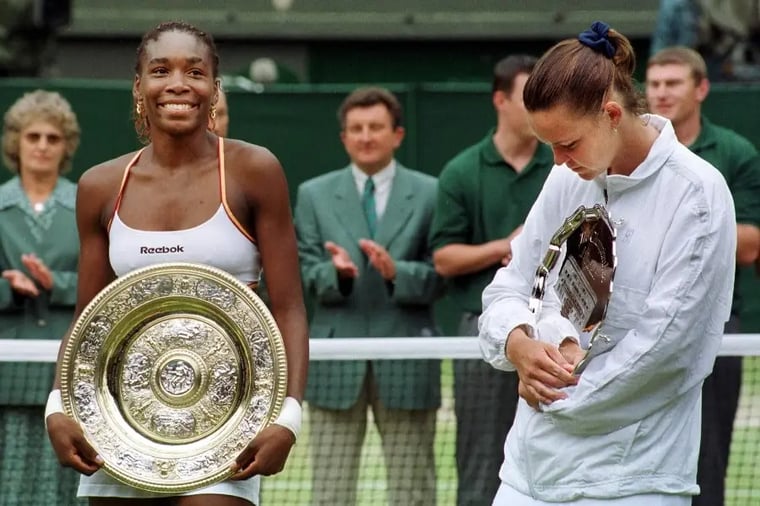
IMAGO / The Independent / Venus Williams Wimbledon Tennis Championships 2000 Venus Williams and Lindsay Davenport after Wimbledon final July 2000 Venus William with Women s Singles Trophy in Centre Court As Lindsay Davenport looks on at Wimbledon Williams defeated Lindsay Davenport and won the match 6-3 7-6.
Wimbledon Today: Media, Spectators, and Finances
Wimbledon is a global media event with extensive reach on television and across Social Media. On site, attendance regularly exceeds half a million visits. On Henman Hill/Murray Mound, fans follow matches on a large screen; food areas and digital formats extend the experience.
Economically, the tournament has seen rising prize funds and stable revenues from TV rights, partnerships, and ticketing. In 2024 the total prize pool was £50 million, and in 2025 £53.5 million; the women’s and men’s singles champions each received £3 million. Equal prize money for women and men has been in place since 2007. In parallel, Wimbledon continues to modernize broadcast technology (including Hawk‑Eye) while keeping the visual identity restrained.
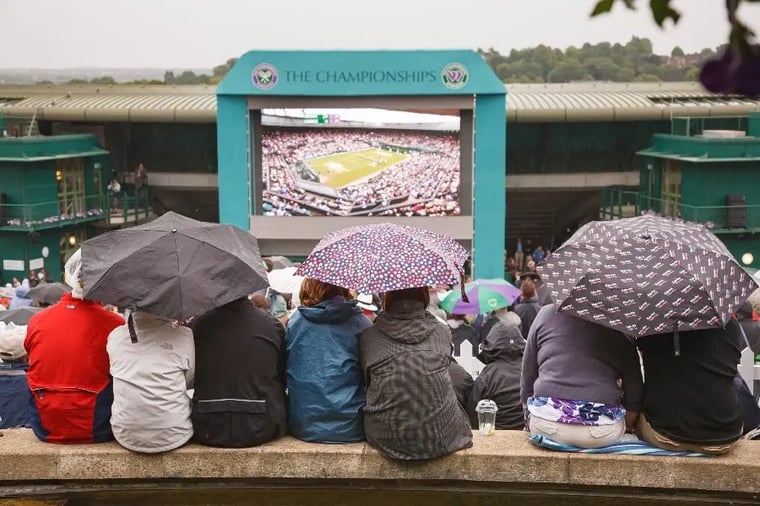
IMAGO / Depositphotos / LONDON, UK - June 24, 2011. Wimbledon tennis match. Crowd watching tournament at the stadium on a big screen from Murray Mount or Henman Hill, London, UK.
Highlights 2024 and 2025
Wimbledon 2024
Carlos Alcaraz defended his men’s title with a straight‑sets win over Novak Djoković, securing his second consecutive Wimbledon crown. He also completed the rare Channel Slam (French Open and Wimbledon in the same year) at age 21. Djoković set a Grand Slam final appearance record.
In women’s singles, Barbora Krejčíková won her first Wimbledon final against Jasmine Paolini in three sets. Paolini made tournament history as the first Italian woman to reach the final in the Open Era. Notably, defending champion Markéta Vondroušová exited in the first round — a rare occurrence in Wimbledon women’s singles.
Wimbledon 2025
In the men’s event, Jannik Sinner celebrated his first Wimbledon title. The top‑seeded Italian defeated Carlos Alcaraz in four sets to become the first Italian men’s champion at Wimbledon.
In women’s singles, Iga Świątek claimed her first Wimbledon crown with a 6–0, 6–0 over Amanda Anisimova. A double bagel in the final is extremely rare and marked a historic entry.
Beyond singles, 2025 particularly showcased Czech doubles tennis, and the tournament leadership continued organizational lines from previous years, including athletes from certain nations competing under a neutral flag and further‑developed sustainability measures.
.webp?width=760&height=507&name=wimbledon-tennis-championships-flags-court%20(1).webp)
IMAGO / Panthermedia / The Championships Wimbledon flags waving with the Centre Court in the background. Major tennis tournament.
At a Glance
Wimbledon combines historical continuity with professional event operations and remains a central reference point in world tennis. Rules, scheduling, and the care of the grass ensure recognizability, while modernization in timing and technology stabilizes delivery. The most recent editions underline the sport’s dynamism: new champions, shifting balances of power, and individual records. For media, brands, agencies, creators, NGOs, and educational institutions, Wimbledon reliably offers relevant content — mindful of its past yet firmly rooted in the present.
IMAGO: Image Content and Licensing — concise and fact‑based
IMAGO works with an international network of partner photographers, agencies, and archives, providing image and video content across Sports, News, Entertainment, Creative, and Archival material. IMAGO has no in‑house photography and does not guarantee exclusivity; instead, it provides clear and flexible licensing models. These include Rights Managed, Royalty Free Classic, and Royalty Free Premium. Each license precisely defines how, where, and for how long content can be used; copyright remains with the respective photographer or agency.
For non‑editorial uses, Model or Property Releases are required where applicable; without these, use is editorial only. IMAGO supports filtering by license category and indicates release status in the metadata only for Creative (stock) images that may be used commercially; Editorial images do not contain release information in their metadata. Access is available via the webshop — either single purchases or credit packages — or through personal consultation with Sales Managers. If a client intends to extend an Editorial image for non‑editorial (commercial) use, the client is responsible for clearing any third‑party rights (e.g., depicted persons, trademarks, properties). Images are licensed for editorial use; commercial use requires a corresponding license (non‑exclusive).
License Sports Images Tailored to Your Needs
Real-time editorial sports images across all major sports, including football, F1, tennis, and more, plus access to the largest editorial sports archives. Flexible licensing and fast support in Europe and worldwide.
Learn more