An overview of our current labeling standards, control mechanisms, and approach to AI-generated and AI-modified content.
Transparency and trust in visual content
The rapid development of generative AI is transforming how visual content is created and used. Today, images and videos can be generated or substantially altered in ways that are not always obvious at first glance. It is therefore becoming increasingly important for publishers, editorial teams, and companies to be able to reliably determine how content was created or modified.
If AI-generated or manipulated content is unknowingly published in the wrong context, the consequences can be serious. In the worst cases, deepfakes or misleading representations can contribute to the spread of misinformation. At the same time, they can damage public trust and the reputation of the media outlets or companies publishing them.
The European Union has responded to this development with the EU AI Act. The regulation entered into force on 1 August 2024, with its provisions being introduced gradually. The transparency obligations under Article 50 have applied since 2 August 2026. Among other things, they are intended to make it easier to determine when certain content has been created or modified using AI.
The Code of Practice on Transparency of AI-generated Content provides important guidance on implementing these requirements. Nevertheless, many aspects of this young and rapidly evolving field have yet to be conclusively resolved. Complex supply chains, diverse international sources, and the sheer volume of content pose particular challenges: IMAGO receives approximately 200,000 new images and videos every day. Reliable classification can therefore only be achieved through a combination of standardized information, technical control mechanisms, and editorial expertise.
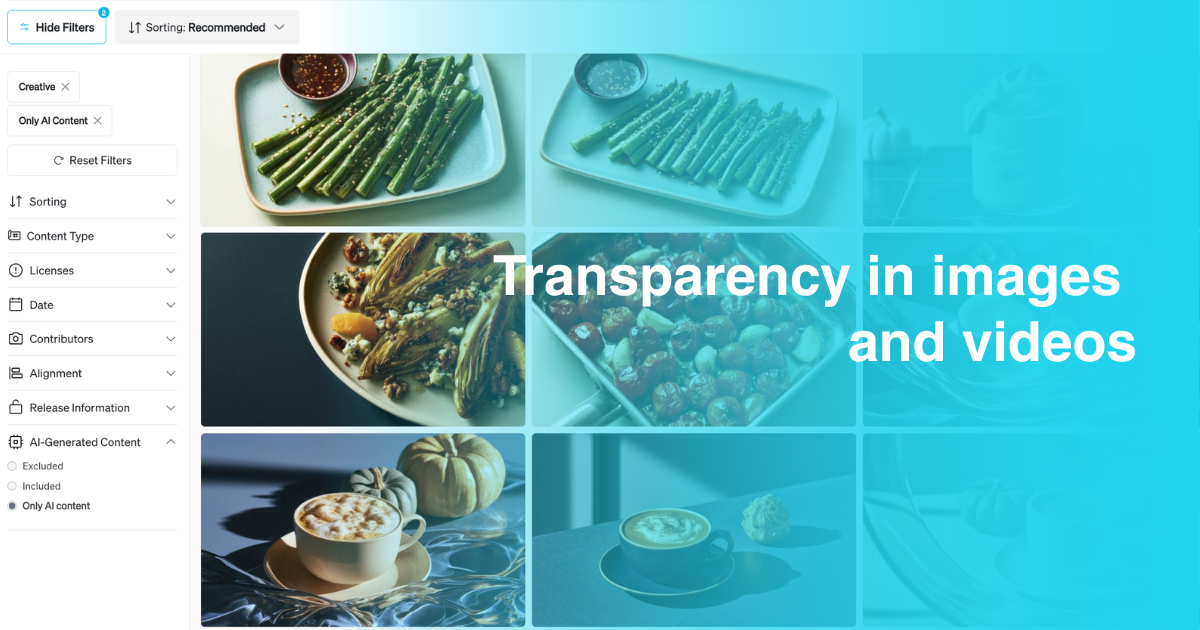
Against this backdrop, IMAGO has developed and implemented specific safeguards and labeling measures. AI-generated and AI-modified content is not displayed under the website’s default settings. Where such content is permitted in the Creative section, it will appear in customers’ search results only if they explicitly enable the AI filter.
We see these measures as the first iteration of an ongoing learning and development process undertaken together with our customers and partners. Below, we explain transparently how we classify and label AI content, which additional control mechanisms we use, and how we continue to develop our processes.
Our commitment
IMAGO aims to be a trusted source of visual content for its customers. At the same time, we see ourselves as a strong partner to professional photographers and agencies, for whom traceable provenance, authenticity, and transparency are essential indicators of quality.
Our goal is not to restrict access to new creative possibilities in principle. At the same time, we want to ensure that AI-generated content and content substantially altered using AI can be classified reliably and does not inadvertently enter editorial contexts.
Editorial and Creative: Different requirements
IMAGO distinguishes between Editorial and Creative content when determining whether AI content is permitted.
Editorial: AI-generated images and videos, as well as AI modifications that alter the substance of the content, are not permitted. Modifications that do not alter the content, for example, minor color or lighting adjustments customary in the industry, are permitted.
Creative: AI-generated and AI-modified material is permitted. Customers who wish to display this content can do so using the filter.
Editorial content
Editorial content documents real events, people, and situations. Its credibility depends to a significant extent on the authenticity of what is shown and on ensuring that the documented subject matter is not altered in a misleading way. Fully AI-generated images and videos, as well as AI modifications that alter their content, are therefore not permitted within IMAGO’s Editorial collection.
This applies in particular to modifications through which people, objects, backgrounds, or other relevant elements are added, removed, or replaced. Such changes can affect the meaning of an image and create a false impression of the events being documented.
There have been isolated cases in the market in the past in which content was deliberately misrepresented or incorrectly labeled. Such incidents are serious. At the same time, it is important to put them into context: given the volume of content processed every day, these are extremely rare exceptions among professional agencies, photographers, and partners.
Precisely because even a single incident can have serious consequences, particularly strict standards apply to Editorial content.
How we distinguish between AI-generated and AI-modified content
For labeling purposes, we generally distinguish between two categories:
- AI-generated: The content was created entirely or predominantly using a generative AI system.
- AI-modified: An existing image or video was substantially altered in terms of its content using generative AI, for example, by adding, removing, or replacing people, objects, or backgrounds.
Photomontages must also be labeled as AI-modified if one or more significant elements were created using generative AI.
However, not every use of an AI-assisted function automatically results in such a classification. Cosmetic or technical adjustments that do not alter the meaning of the content, such as brightening, color correction, noise reduction, or minor sharpening, are also permitted under the Code of Practice.
Borderline cases in the assessment
There are grey areas between purely technical optimization and a modification that materially affects the content. The decisive factor is therefore not simply whether AI was used during a particular step, but also what impact the modification has on the meaning and context of the content.
One example is anonymizing a vehicle registration plate. Whether the plate is obscured manually or with the help of an AI-assisted tool does not change the purpose of the modification. In both cases, the edit is intended to protect personal information rather than create a new visual narrative.
A modification must be assessed differently if AI is used to add new elements or alter existing ones in a way that creates a different impression of the situation shown.
Our aim is to label relevant modifications transparently without unnecessarily restricting the appropriate use of technical tools. We therefore review the criteria continuously and refine them in line with technological and regulatory developments.
How the information reaches IMAGO
Reliable labeling requires us to receive the correct information in the appropriate format from our professional partners. Only then can the chain of information be maintained from the creation of content through its transmission and processing to its provision to our customers.
Our suppliers are required to provide the standardized IPTC metadata value “Digital Source Type.” This value contains information about how the relevant content was created and whether it is AI-generated or AI-modified.
Based on this metadata, IMAGO can classify the content accordingly, manage its availability, and provide customers with its AI status in both visible and machine-readable formats.
Additional mechanisms
With approximately 200,000 new images and videos arriving every day, it is not possible to review every item of content fully and manually before adding it to the collection. IMAGO therefore uses several coordinated control mechanisms.
Text-based classification
In addition to reviewing the metadata provided, we check keywords and image descriptions for terms that may indicate AI-generated or AI-modified content.
At present, this approach may result in more content being excluded than necessary. We are deliberately taking a cautious approach: when in doubt, protecting our customers takes priority. At the same time, we are working to improve our text-based classification and reduce unnecessary exclusions.
Manual and targeted checks by the picture desk
Our picture desk is made up of 16 experienced professionals, some of whom have worked in the industry for more than 25 years. The team operates seven days a week, manually reviews content, and responds to reports quickly and in a targeted manner.
Particular attention is paid to sensitive subjects, conspicuous content, specific sources and regions, and reports from customers or partners. Where necessary, the picture desk uses additional technical tools and performs more extensive cross-checks. If irregularities are identified, these are communicated and the relevant content is hidden. The matter is also reviewed with the suppliers to prevent similar errors in the future.
This combination of structured metadata, text-based checks, cross-checks, and editorial expertise enables a level of control that takes account of both the high daily volume of data and the particular sensitivity of visual content.
What happens in the event of possible mislabeling
Despite all safeguards, it is not possible to rule out completely that an individual item may initially be labeled incorrectly. Such cases are extremely rare. Nevertheless, we take every single case very seriously.
As soon as we become aware of possible mislabeling, we initiate an immediate review. As a precaution, the relevant content is removed from the collection or hidden until the matter has been clarified. We then review its provenance, the metadata provided, and its editing history together with the relevant supplier.
If mislabeling is confirmed, we correct the AI status and inform any customers who have already obtained the relevant content. At the same time, we investigate how the error occurred and what additional measures are required to prevent it from happening again.
Depending on their cause, severity, and frequency, missing or incorrect information may have clear consequences for the supplier concerned. These range from mandatory corrective and improvement measures to the termination of the business relationship.
The insights gained from every incident are incorporated into the ongoing development of our processes.
Where AI content is available
IMAGO website with the filter enabled
AI-generated and AI-modified content is excluded from display on the IMAGO website by default. It does not appear in regular search results or in other areas displayed under the standard settings.
Customers can use the AI filter to actively include this content in their search results or display AI content exclusively.

API, FTP and Picturemaxx
AI-generated and AI-modified content is not provided through the following delivery channels:
- IMAGO API
- FTP Push
- Picturemaxx
This is intended in particular to prevent appropriately labeled content from inadvertently entering editorial systems or production processes through automated delivery channels.
How AI content is labeled
Visible labeling
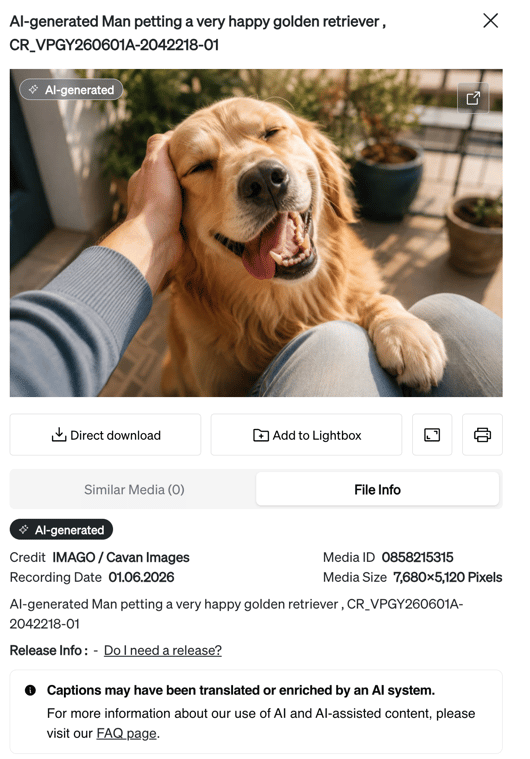
AI-generated and AI-modified content is visibly labeled on the IMAGO website in the preview, individual item view, and lightbox. The relevant notice appears in the upper-left corner of the image or video and in its description.
Depending on how the content was created or modified, we use the following labels:
- AI-generated
- AI-modified
IMAGO is continuously developing its visible labeling. Additional labels in various areas of the website are planned as the next steps.
Machine-readable labeling
In addition to the visible label, we record the AI status technically on the page: as structured data in accordance with schema.org and as an attribute directly attached to the image or video element. This allows search-engine crawlers, browser extensions, and automation tools, for example, to read the status without a person seeing the label. The same value is embedded in delivered files as IPTC metadata (“Digital Source Type”), which can be displayed by any standard image-editing or digital asset management system.
AI-assisted content captions
AI-assisted applications now offer photographers and agencies a wide range of possibilities. Beyond basic image editing, they can, for example, help create high-quality captions in a short period of time, translate text, and enrich descriptions with relevant keywords and additional information. For customers, this can mean better content discoverability and more informative descriptions.
Because many agencies and partners now use this kind of technical assistance and because its use cannot always be traced clearly throughout the entire supply chain, IMAGO has opted to provide a general transparency notice. This fulfills the transparency requirements of the EU AI Act and indicates that captions may have been translated or enriched with the help of AI.
The notice does not mean that all partners use AI-assisted applications or that every caption has been processed using AI. It applies exclusively to the accompanying text, not to the image or video itself. Labeling every individual processing step would currently require considerable effort without providing customers with a corresponding additional benefit. We therefore consider the general notice to be the most transparent and practical solution at present.
AI-assisted search functions at IMAGO
In addition to labeling content, IMAGO also uses AI for features that assist customers with image research. These features do not modify the content offered; instead, they help customers find suitable images more quickly.
People filter
The people filter uses AI-assisted facial recognition to find images featuring selected individuals.
Learn more about the people filter and how to use it
Reverse image search
Reverse image search can be used to find images that are visually similar to a supplied reference image.
Learn more about reverse image search
Outlook and next steps
We do not regard our current labeling processes as a finished solution, but rather as the beginning of an ongoing development process. IMAGO maintains close dialogue with customers, partners, and industry associations and continuously evaluates new regulatory, technological, and market developments.
On 26 June 2026, the Bundesverband professioneller Bildanbieter (BVPA; German Association of Professional Image Providers) published its position paper, „Vertrauen in visuelle Informationen sichern – Verantwortung gemeinsam wahrnehmen“ (“Safeguarding Trust in Visual Information—Taking Responsibility Together”; in German). Developed together with member agencies, it lays the groundwork for responsible handling of AI-generated and manipulated images.
We are also monitoring which technical standards become established for labeling the provenance and editing history of visual content. These include C2PA, Content Credentials, and JPEG Trust. These initiatives are intended to make provenance information, editing steps, and the use of AI traceable in machine-readable formats.
IMAGO is continuously assessing how such standards can be meaningfully integrated into its own processes. The requirements of our customers and suppliers are just as important in this regard as the technical feasibility of applying them to the volume of data processed every day.
Open dialogue is an essential part of this process for us. Requirements, observations, and feedback help us develop our measures further and ensure that we remain a trusted source of visual content and a reliable partner to professional image providers.
Contact us directly through your personal representative, via our contact form, or by emailing contact@imago-images.de.


