

The search query “largest stadium in the world” sounds simple at first. In practice, it is not. When it comes to stadiums, it is never just about a bare number, but always about use, renovation phases, safety regulations, visual impact, and historical significance. That is exactly why it makes sense to read the largest stadiums in the world not merely as entries in a seating-capacity ranking, but as monuments of sport — as places where architecture, public life, and memory come together.
For professional users, this is more than a fan topic. According to IMAGO’s buyer persona, editorial teams, agencies, brand managers, and producers often work under time pressure, need legally secure imagery, and look for visuals that do more than illustrate a topic — they help frame and interpret it. Quality, timeliness, legal clarity, and an efficient workflow are all central. That is precisely why major stadiums are so valuable to picture desks: they deliver context, recognizability, and atmosphere in a single image.
This article therefore follows a dual perspective. It answers the question of the largest stadium in the world in a football context, and it shows why stadium images and sports architecture photography are especially effective when it comes to large arenas. A stadium is never just a structure. It is a stage, a symbol, and a place of memory.
What “Large” Even Means When It Comes to Stadiums
Large is not a static term when it comes to stadiums. One and the same arena can appear with different capacities depending on construction phase, safety approval, or hospitality build-out. Spotify Camp Nou is currently the best example of this: FC Barcelona speaks of an available capacity of 62,652 spectators in the ongoing reopening, but in the long term the venue is expected to reach 105,000 seats. Anyone reading stadium rankings therefore always has to ask: Is this the current approved capacity, the target capacity, or the historical peak?
The FNB Stadium in Johannesburg shows just as clearly how much numbers depend on context. Official South African sources cite either 87,436 or 94,736 seats, depending on the presentation. That is not a contradiction in the simple sense, but a sign that configuration, communication purpose, and operating mode all play a role. Anyone writing seriously about the largest stadiums in the world therefore has to consider capacity at all times — but never in isolation.
For this article, what counts is the stadium capacity relevant to football operations plus the arena’s actual role in the global football imagination. So this is not just about concrete volume, but about stadiums that genuinely function as football venues — as club homes, national stadiums, World Cup stages, or iconic sporting sites.
The Largest Stadium in the World: Rungrado 1st of May Stadium
If the question is asked strictly in terms of official capacity, the Rungrado 1st of May Stadium in Pyongyang is considered the largest stadium in the world. Britannica describes the structure on Rungra Island in the Taedong River as an arena completed in 1989 with 150,000 seats, eight stories and around 207,000 square meters of total floor area. In pure size terms, it sets a benchmark that hardly any other football venue can match.
Its architectural effect goes beyond sheer scale. Britannica explains the form through 16 concrete arches that resemble a lotus blossom; added to that is a sweeping roof and an overall impression that feels more like a state monument than a typical club stadium. That is exactly what sets Rungrado apart from many Western arenas: it feels less intimate and less football-centered, but all the more powerful as a symbol of scale, power, and staging.
For stadium images, Rungrado is therefore a special case. The strongest motifs do not necessarily emerge at eye level by the touchline, but from a distance: in the wide shot, in symmetrical axes, in the contrast between human scale and built form. Anyone looking for sports architecture photography will find in this stadium an extreme case — a place where sports architecture almost tips into political visual language.
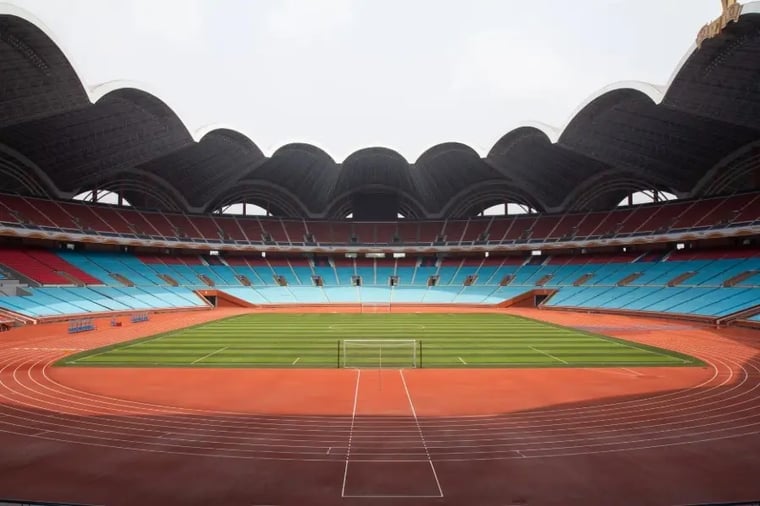 IMAGO / Depositphotos / The Rungrado 1st of May Stadium on Rungra Island in Pyongyang, North Korea.
The Largest Stadiums in World Football: Defining Arenas in Profile
Spotify Camp Nou, Barcelona
In Europe, Spotify Camp Nou remains the reference point. The official Spain portal describes it as the largest football stadium in Europe, and FC Barcelona has been publicly documenting the phased reopening since the modernization began. Since the approval of Phase 1C, available capacity has stood at 62,652 spectators. That alone shows it: scale here is a process, not just an end state.
Even more interesting is the stadium’s future form. The Espai Barça project envisions an arena for nearly 105,000 spectators, fully covered, technically upgraded, and at the same time intentionally open in design. FC Barcelona emphasizes the Mediterranean character, the large terraces, the stronger integration into the surrounding neighborhood, and a roof structure of around 48,000 square meters. For stadium images, that is ideal: Camp Nou remains not only large, but architecturally legible — as a link between club identity, urban location, and media suitability.
 IMAGO / STEINSIEK.CH / Night view of the modernization of Spotify Camp Nou in Barcelona, Spain.
Wembley Stadium, London
Wembley represents a different kind of scale. With 90,000 seats, it is the largest sports venue in the United Kingdom and, according to its official stadium profile, the second-largest stadium in Europe. At the same time, it is England’s national stadium and therefore less a club shrine than an institutionalized football stage. That status alone changes the visual language: Wembley almost always stands for events of national or international significance.
Its iconic feature is the 133-meter-high arch, which Wembley itself describes as the longest single-span roof support in the world. Added to that is the retractable roof. In practice, that means a single wide-angle image is often enough to make the location instantly identifiable. For sports architecture photography, Wembley is therefore especially efficient — the silhouette explains the setting almost on its own.
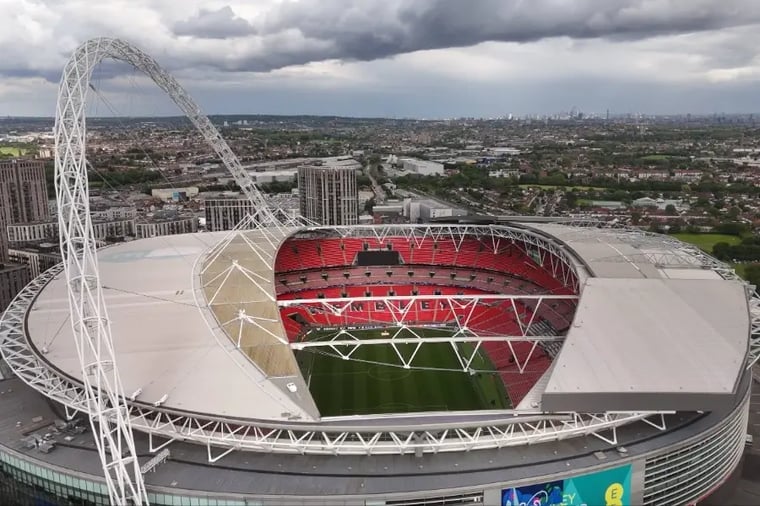 IMAGO / Zoonar / Erik Lattwein / Spectacular view of Wembley Stadium in London, May 2024.
FNB Stadium, Johannesburg
The FNB Stadium, still familiar to many under the name Soccer City, is one of the clearest examples of how strongly regional identity can be translated into sports architecture. Official South African sources cite either 87,436 or 94,736 seats, depending on the presentation; at the same time, the arena is described as a “Calabash” or “African Pot”. The form, façade structure, and lighting concept therefore deliberately draw on an image from everyday life and translate it into a stadium of continental scale.
Historically, the venue carries far more than football alone. Stadium Management South Africa points to Nelson Mandela’s first major speech there in 1990 shortly after his release from prison, and to the memorial service for Mandela in 2013; at the same time, the stadium was the main stage of the 2010 World Cup. This layered significance is exactly what makes the FNB Stadium so powerful for picture desks: a stadium photograph can simultaneously convey sport, politics, memory, and public life.
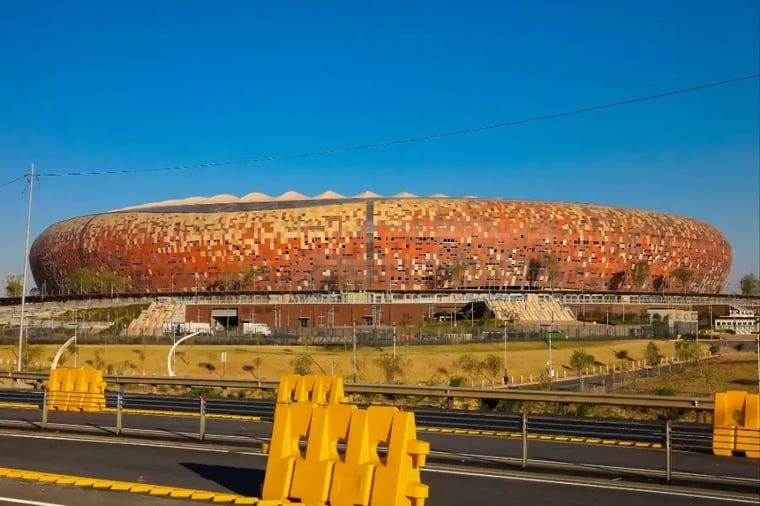 IMAGO / Depositphotos / Johannesburg, South Africa, September 11, 2011, FNB Soccer Stadium in Soweto.
Lusail Stadium, Qatar
The Lusail Stadium is one of the flagship new builds of the most recent World Cup era. The Qatar Football Association describes it as the largest World Cup venue by capacity; the design is said to be inspired by the interplay of light and shadow in traditional Arabic lanterns. Its official total capacity stands at 88,966 seats. That makes Lusail not only large, but also a visual object designed from the outset for global circulation.
In football’s collective memory, Lusail has anchored itself through the 2022 World Cup final. FIFA notes that 88,966 spectators attended that match — the exact backdrop against which Lionel Messi won the title. For stadium images, this means Lusail stands less for decades of accumulated tradition than for maximum contemporary impact. Golden shell, smooth surfaces, controlled night lighting, global TV staging — all of this makes the arena a prototype of the media-optimized mega-stadium.
 IMAGO / Wirestock / The Lusail Stadium in Doha, Qatar.
We advise you on the right images for sports highlights — including customized media packages.
Estadio Banorte, Historically Estadio Azteca, Mexico City
Historically known as Estadio Azteca and now officially called Estadio Banorte, this stadium combines monumentality with football mythology like almost no other place. The official Mexico City portal lists a currently adjusted capacity of 87,000 seats and notes that the venue was designed by Pedro Ramírez Vázquez and Rafael Mijares in a way that echoes the volcanoes surrounding the Valley of Mexico. That is more than an architectural footnote: stadium construction here was explicitly conceived as a national symbol.
FIFA calls the stadium a “true cathedral of football” and emphasizes that in 2026 it will become the first stadium ever to host a third men’s World Cup. Five matches are planned, including the opening game on June 11, 2026. At the same time, the venue is inseparable from Pelé and Diego Maradona, who had some of their greatest World Cup moments there. Anyone using a stadium image from Mexico City is therefore almost automatically working with several layers of time at once: 1970, 1986, and 2026 exist within the same frame.
 IMAGO / ZUMA Press Wire / Marco Gonzalez / Fans attend the friendly match between Mexico and Portugal at Banorte Stadium on March 28, 2026, in Mexico City.
TM Stadium Nasional, Bukit Jalil
Southeast Asia also has an arena that is often underestimated in global comparisons: TM Stadium Nasional in Bukit Jalil. The official Malaysian stadium authority lists 85,500 seats, an elliptical open-air form, around 76,000 square meters of area, and the striking overlap of three spectator tiers. Construction began in 1994, and the stadium was completed in 1998 in connection with the Commonwealth Games in Kuala Lumpur.
From an image perspective, Bukit Jalil is especially interesting because the arena combines classic bowl geometry with modern event infrastructure. It is less globally charged than Wembley or Azteca, but that can be an editorial advantage. For international publications, it opens up perspectives on football culture beyond the same recurring Western symbols — and those are exactly the kinds of motifs that often make stadium images feel fresher and more relevant.
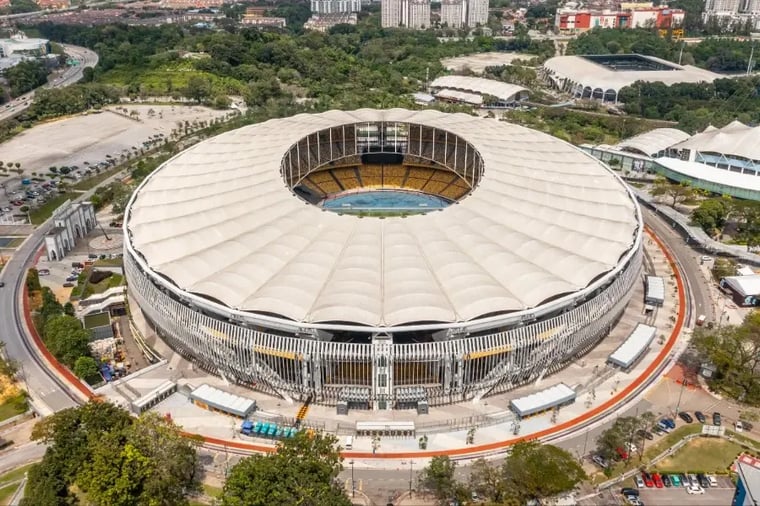 IMAGO / Depositphotos / Malaysia, Kuala Lumpur, January 2023 — aerial view of the National Stadium Bukit Jalil.
Signal Iduna Park, Dortmund
To readers who focus only on rankings, Signal Iduna Park in Dortmund can sometimes seem almost “small,” even though at 81,365 spectators it is the largest stadium in Germany. Borussia Dortmund itself describes it as a symbol of passion, tradition, and unforgettable moments. That gets to the heart of it: here, visual power is not only a question of capacity, but above all a question of density.
The decisive factor is the South Stand. According to BVB, it holds space for almost 24,454 people and is therefore the largest standing terrace in Europe. Hardly any other place shows so clearly that size in football is not measured only horizontally. The famous “Yellow Wall” is a lesson in how architecture and crowd intensify one another. For sports architecture photography, that is central: here, the structure works not despite the mass of people, but through it.
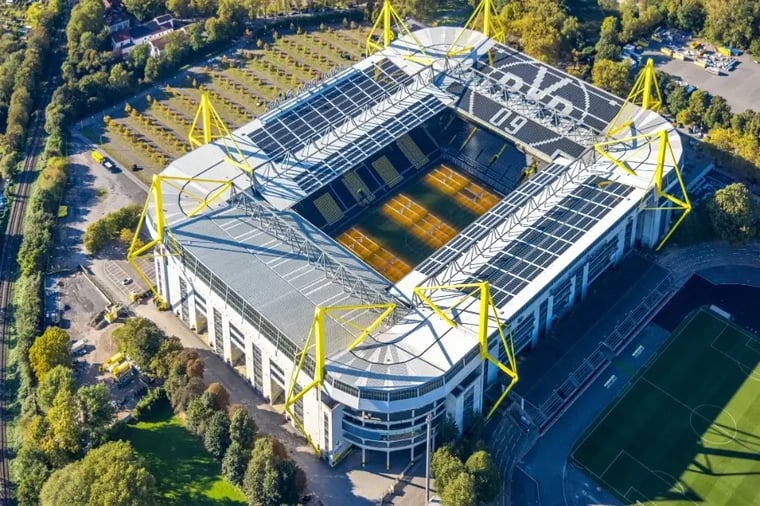 IMAGO / Hans Blossey / Aerial view of Signal Iduna Park in Dortmund, North Rhine-Westphalia, Germany.
Maracanã, Rio de Janeiro
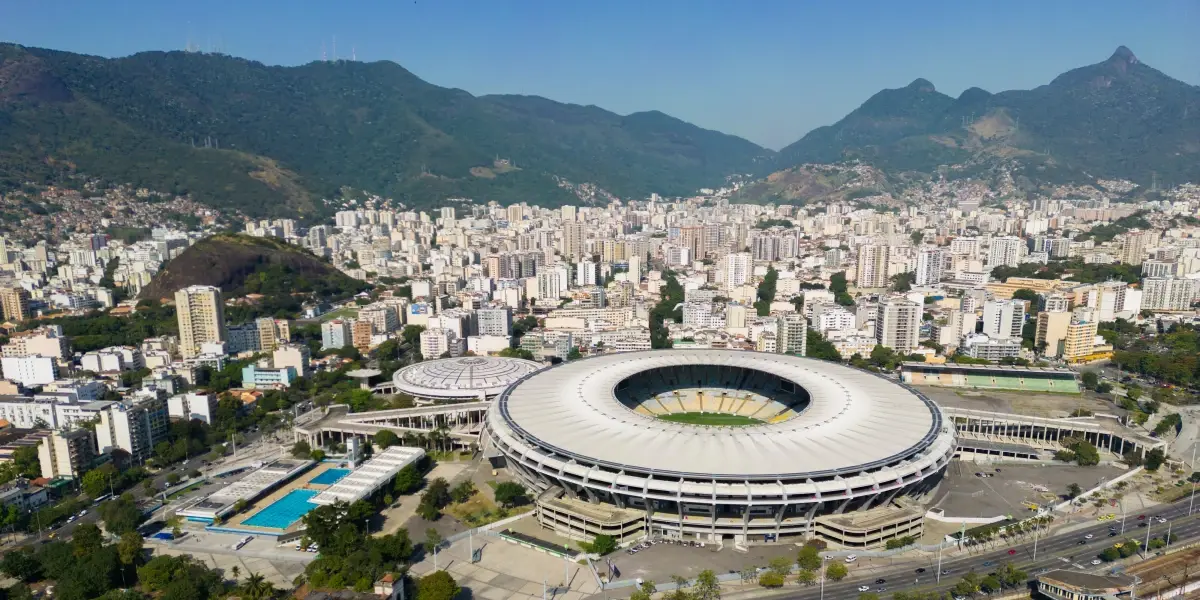
The Maracanã in Rio de Janeiro is now much smaller than it was in its early years, but historically it remains one of the greatest addresses in world football. The official tour site lists a current capacity of 78,838 spectators after the modernization for the 2014 World Cup and emphasizes that the stadium now meets modern requirements in terms of safety, logistics, and sustainability. That is exactly what makes Maracanã so interesting: it is not a preserved relic, but a modernized myth.
Its symbolic weight is fed by events. FIFA recalls the Maracanazo of 1950, when Uruguay shocked Brazil in the decisive match, and the 2014 World Cup final, in which Mario Götze fired Germany to the title against Argentina. Names such as Pelé, Romário, Bebeto and Neymar also appear in FIFA’s retrospective. Maracanã thus shows, in exemplary fashion, what great stadiums do: they store sporting history so densely that even a single wide shot can trigger memory.
 IMAGO / Depositphotos / Rio de Janeiro, Brazil — August 4, 2022: Aerial view of the world-famous Maracanã Stadium.
Stadium Images and Sports Architecture Photography: What Matters Visually
Stadium images are especially powerful when they show more than action. The actual game image — goal celebrations, duels, choreography — almost always gains strength when the location clearly helps tell the story. Major stadiums provide four things at once: scale, recognizability, atmosphere and temporal context. An image from Wembley often needs only the arch and upper tier, one from Dortmund only a section of the South Stand, one from Lusail only the façade and lighting. Scale here is therefore not just physical, but semiotic: it makes places immediately legible.
For sports architecture photography, what matters is how a stadium formally builds its identity. Rungrado works with the lotus-like roof figure, FNB with the Calabash metaphor, Camp Nou with open Mediterranean terrace architecture, Bukit Jalil with the layered three-tier bowl. For editors, these features are not decoration, but orientation. The more clearly a stadium is recognizable in an image as a specific place, the faster that visual can generate context in the flow of an article, a dossier, or a social post.
Added to that is the historical layering. This is the point at which large arenas become especially valuable for picture desks. In Estadio Banorte or Azteca, Pelé, Maradona, and the 2026 World Cup virtually lie on top of one another; in Maracanã, Maracanazo, the Götze final, and Olympic moments overlap; Lusail is instantly tied to the most recent global tournament through Messi. A good stadium photograph therefore often shows not only where something is happening, but also within which historical line it is meant to be read.
Editorially, it is therefore not only celebration images that are especially strong, but also establishing shots: exterior views before kickoff, wide shots just before the teams walk out, empty architecture on the morning after a final, or masses of fans in access corridors. Such images carry narratives. The fact that image archives need to provide different perspectives for different storytelling goals is also emphasized in current IMAGO blog posts — explicitly in connection with sports history, sequences, and visual documentation.
Anyone looking for sports architecture photography, then, is usually not looking for “beautiful buildings with grass,” but for the point at which built form, crowd, light, and history interlock. That is exactly where major stadium visuals differ from generic sports imagery: they carry narrative depth. They can sustain a subject even when no goal is being scored.
Why Large Stadiums Matter for Editorial Teams, Brands, and Documentaries
For IMAGO’s target audience — editorial teams, marketing teams, agencies, producers, and communications managers — major stadiums are therefore highly functional visual venues. They help make a subject instantly legible under deadline, they add geographic and historical depth to sports coverage, and they can be reused in retrospectives, anniversaries, player portraits, World Cup dossiers, or city stories. According to the buyer persona, these users actively look for image quality, legal certainty, variety, and efficient access.
There is also a practical advantage: a stadium is often an evergreen visual asset. An image of Azteca works in a text about Maradona, Pelé, or the 2026 World Cup. A Camp Nou motif fits club history, renovation, fan culture, or urban development. A photograph from Maracanã can support a World Cup ranking just as well as a retrospective on Brazilian football history. For professional content in particular, this kind of multiple readability matters enormously.
How These Images Can Be Licensed Securely Through IMAGO
Most importantly: an image license does not transfer ownership of the image. It regulates the right of use, while copyright remains with the respective creator or agency. That distinction is crucial for editorial teams, brands, and producers because it determines how, where, for how long and in which medium an image may be used.
IMAGO webshop works with several standard licensing models:
-
Rights Managed (RM) is generally suitable for clearly defined, one-time uses, such as a specific article, a particular social post, or a defined print run.
-
Royalty Free Classic (RF) is designed for repeated use without each individual use having to be reported again.
-
Royalty Free Premium (RF Premium) is particularly flexible and can — provided the relevant additional rights are in place — also cover broader projects such as print, campaign elements, packaging, or merchandising. For professional teams, this matters because licensing can be matched more precisely to format, reach, and budget.
Especially with sports images, the distinction between editorial and commercial use is central. Editorial means reporting, documentation, information, or educational purposes — for example an article about Wembley Stadium, a World Cup chronicle on Azteca, or a picture feature on the largest stadiums in the world. Commercial, by contrast, includes advertising, sponsorship, product marketing, packaging, or merchandising. A stadium image can therefore fall into a different legal category depending on the context, even if the image itself appears identical at first glance.
As soon as people or private places or objects are clearly recognizable in an image and the use becomes commercial, model releases or property releases may become relevant. IMAGO explains this explicitly: model releases concern the consent of depicted individuals, while property releases concern permission from owners of recognizable objects, buildings, or artworks. Release status is displayed in the metadata, and searches can be narrowed using the corresponding filters. This is particularly important for stadium images when, alongside the architecture, clearly identifiable fans, celebrities, artworks, or private areas appear in the frame.
For practical purchasing, IMAGO offers several routes:
-
In the webshop, single licenses can be purchased directly for specific publications.
-
For regular buyers, there are credit packages, whose balance remains valid for 365 days according to IMAGO.
-
For larger volumes, recurring needs, or customized contract models, the Sales Manager comes into play.
This mix of self-service and personal consultation fits the IMAGO customer profile precisely: work with legal certainty, save time, purchase at scale, and still not be left alone with more complex projects.
There is also the portfolio advantage. The buyer persona describes IMAGO as a global partner with more than 800 million images and videos across sport, news, politics, entertainment, archive, and creative topics. For editorial teams and organizations, that matters especially because major stadium themes rarely end with a single shot: in many cases, you need an exterior view, a wide shot, a fan image, a historical scene, and a second visual for social or print. At that point, it is not only image quality that matters, but the reliability of the workflow as well.
Closing Thought
Anyone searching for “largest stadium in the world” gets a clear first answer in the football context: Rungrado 1st of May Stadium. Anyone who wants to truly understand the subject, however, has to go further. The largest stadiums in the world are not just places that hold large numbers of people. They are carriers of architectural identity, repositories of history, and visual shortcuts for entire eras of sport.
For professional content, what matters is therefore not only which stadium holds the most people. What matters is which image tells which story. That is where the power of stadium images and sports architecture photography lies: they make sport visible before a single sentence is read. And when those images need to be used with legal certainty, contextual depth, and workflow readiness, a clean licensing framework is not an appendix, but part of quality itself.
To discuss your specific needs or explore personalized solutions, we invite you to contact our Sales team. Our specialists can guide you through the image selection and licensing process, ensuring you find the perfect visual content for your sport projects.
License Sports Images Tailored to Your Needs
Real-time editorial sports images across all major sports, including football, F1, tennis, and more, plus access to the largest editorial sports archives. Flexible licensing and fast support in Europe and worldwide.
Learn more